Ultrasonic sensors are one of the most versatile and widely used sensors in electronics, robotics, and automation projects. If you’re a student, hobbyist, or maker, understanding how these sensors work is essential for building distance measurement systems, obstacle-avoidance robots, smart bins, and IoT projects.
In this article, we explain how ultrasonic sensors work, their principle of operation, applications, and why they are important in electronics projects.
🔹 What Is an Ultrasonic Sensor?
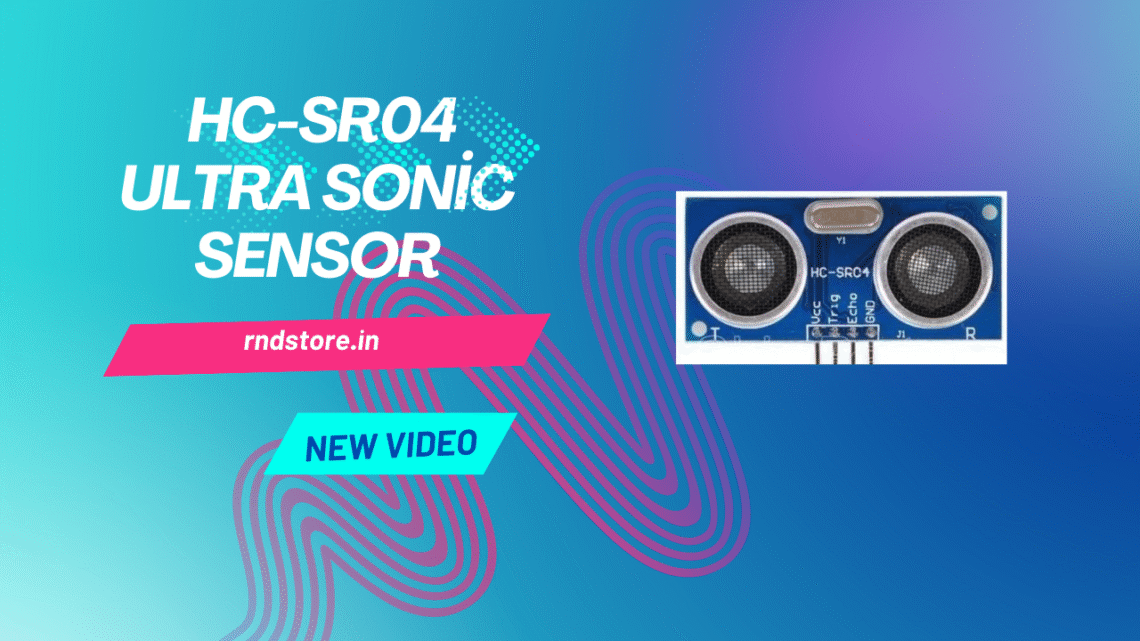
An ultrasonic sensor is a device that measures distance by using high-frequency sound waves (ultrasound) beyond the range of human hearing (typically around 40 kHz). Unlike infrared sensors, which rely on light, ultrasonic sensors use sound to detect objects, making them reliable in dark or reflective environments.
The most popular ultrasonic sensor for beginners and Arduino projects is the HC-SR04.
⚙️ How Ultrasonic Sensors Work – The Theory
Ultrasonic sensors operate on the principle of echo reflection, similar to how bats navigate using echolocation.
1. Components of an Ultrasonic Sensor
A typical ultrasonic sensor consists of:
- Transmitter (Trig pin) – Sends out ultrasonic pulses
- Receiver (Echo pin) – Detects the reflected sound waves
- Control circuitry – Measures time and calculates distance
2. Distance Measurement Process
The distance measurement involves these steps:
- The Arduino or microcontroller sends a trigger signal to the sensor.
- The sensor’s transmitter emits a short ultrasonic pulse.
- The pulse travels through the air and reflects off any object in its path.
- The receiver picks up the echo when the pulse bounces back.
- The sensor measures the time interval between sending the pulse and receiving the echo.
- Using the speed of sound, the distance is calculated with the formula:
Distance=Speed of Sound × Time2\text{Distance} = \frac{\text{Speed of Sound × Time}}{2}Distance=2Speed of Sound × Time
The division by 2 accounts for the pulse traveling to the object and back.
🔹 Key Parameters to Consider
- Measuring Range: HC-SR04 typically measures distances from 2 cm to 400 cm.
- Accuracy: ±3 mm under ideal conditions.
- Field of View: Usually around 15° cone for detection.
- Operating Voltage: 5V DC for Arduino compatibility.
🧠 Why Ultrasonic Sensors Are Popular
Ultrasonic sensors are widely used because:
- Non-contact measurement – Objects do not need to touch the sensor.
- Works in darkness – Unlike optical sensors, they don’t require light.
- High accuracy – Reliable for most DIY and robotics projects.
- Affordable and easy to use – Perfect for Arduino, IoT, and robotics beginners.
🛠 Applications of Ultrasonic Sensors
Ultrasonic sensors are used in a variety of projects and industries:
- Obstacle Avoidance Robots – Detect walls and obstacles in real-time.
- Automatic Water Level Detection – Measure water levels in tanks.
- Smart Parking Systems – Detect car positions in parking slots.
- Proximity Alarms – Trigger alarms when objects come too close.
- IoT Distance Sensing Projects – Integrate with Arduino for smart home devices.
- Industrial Automation – Detect presence, measure gaps, or control material flow.
🔹 Ultrasonic Sensor with Arduino – Practical Example
A simple Arduino project uses the HC-SR04 to measure distance:
- Connect Trig and Echo pins to Arduino digital pins.
- Send a 10-microsecond trigger pulse to the Trig pin.
- Read the pulse duration from the Echo pin.
- Calculate distance using the formula.
- Display results on the serial monitor or an LCD.
This project forms the foundation of many beginner robotics and IoT projects.
🏁 Conclusion
Ultrasonic sensors are essential components for measuring distance accurately and safely in electronics projects. Their non-contact operation, ease of use, and compatibility with Arduino and microcontrollers make them perfect for students, hobbyists, and makers.
Whether you’re building a smart dustbin, obstacle-avoidance robot, or water-level detector, understanding how ultrasonic sensors work will help you design better projects.
🛒 Buy Ultrasonic Sensors and Related Components at rndstore.in
https://rndstore.in
📦 Ships Across India | Perfect for Arduino & Robotics Projects
🎓 Hands-on Learning for Students & Makers